Friday, September 27, 2013

Preserving the Harvest

This month's healthy cooking class focused on local foods - and how to eat locally year round!

Farm-fresh vegetables ready to be preserved! 

Participants watch as Renee preps peppers for freezing.

Shredded zucchini is great out of the freezer, thawed and baked into bread! 


Home-made vegetable stock is easy to put together from left-over onion peels, carrot tops and potato skins! 


Our ice bath ready to cool down the blanched broccoli


Purple broccoli, post-steaming, is quickly cooled before going into the freezer.

Fresh vegetables ready for the freezer! 

Thursday, September 19, 2013

Seed Saving 101


For those who were unable to make it to the Seed Saving workshop this month, here are some tips, notes and photos!


Why save seeds?
  • It's Cheap! And you end up with basically a free crop for next year
  • It's an important way to save heirloom varieties that are otherwise being lost from our food system
  • Plants adapt to local conditions and can grow better next year

What do I need?

Depending on the seeds you are planning to save, basic tools you'll need are knife, cutting board and paper towel. If tomato seeds are on your list, then you'll also need a jar with lid and water.


Which seeds to save or not save?

  • Squash and sweet corn (male/female flower parts) can cross-pollinate and may not necessarily be good the second year
  • Carrots/beets are biennial plants, so it takes two years for them to go to seed. It's possible, just more difficult.
  • Tomatoes, peppers, beans and peas are easy plants to save seed from.
  • F1 hybrid seeds were cross-bred and may not produce desirable results (or not even produce at all!) Open pollinated seeds are heirloom varieties that will yield 'true' generations.
How to save seeds, some common examples:
  • Save seed from the most vigorous, healthy plants as these will have the 'strongest' seeds (e.g. natural selection)
  • Tomatoes/Cucumbers (see photos below): allow fruit to fully ripen and scoop out seeds and pulp. Place in jar of water for 24-76 hours, to ferment (this releases the lining on the seed, allowing for future germination), stirring the seeds every day. Once seeds have sunk to the bottom, pour liquid away and rinse. Dry on paper towel (preferably out of sunlight) and once completely dry (up to 3 weeks!) place in envelope.
  • Peppers: Let pepper fully ripen on fruit and wait until skin starts wrinkle. Remove from pepper and let dry on paper towel. Then place in envelope.
  • Peas/Beans: Allow pod to ripen on stalk and start to dry and turn brown. Spread them out on a tray indoors to dry, waiting at least two weeks before shelling. Or you can leave them in the pod until next spring when ready to plant.
  • Carrots/Beets: As a biennial plant, carrots (like beets) won't flower until early into the second year after planting. If you want to collect carrot seeds, leave a few in the ground to overwinter and collect seeds once the flowers have seeded and dried the following spring/early summer.

How to store seed:

  • Seeds are best stored in paper envelopes in a cool, dark area where temperatures don't fluctuate much.
  • Make sure to label your envelopes well with variety type and year. You may even want to leave a few  notes for yourself to remember for next year.


Tomato Seed Saving Photos
When you cut open your tomatoes, you'll see the seeds surrounded by their pulp/coating.
Squeeze all of this out into the jar.


After you squeeze out the pulp and seeds into your jar, throw the rest of your
tomatoes into a blender to make a quick salsa or add them
to your compost pile for next year's crop.


Thursday, September 5, 2013

Field Trip: Central Greens


Yesterday, we took a trip to Central Greens, Milwaukee's newest aquaponics venture focused on the innovative fish-as-fertilizers model.  Central Greens, located near Miller Park, is a family-run business located on a once-run down site in the Story Hill neighborhood of Milwaukee's west side.

Fish

Although Central Green's main focus is fresh salad greens and herbs, fish like tilapia play a major role in their business model. Simply stated, water is circulated through large fish tanks where it picks up nutrients from the fish waste and is then circulated through a hydroponic greenhouse full of lettuce, basil, and other greens and herbs.

This not-too-large 'fish house' stays nice and warm thanks to the large tanks of heated water


Inside the fish tank: a tube system helps to circulate the water
The powerhouse of the system: tilapia


Emma showing CORE/El Centro interns how the water is filtered before it heads out to 'feed' the plants.


Fertilizer

While Central Greens is able to sell a number of tilapia to restaurants for additional revenue, the greens are where they really see their 'green.'

Coir (coconut husk) forms the base for some seed starting trays


Small plants on their way to the hydroponic green house


Central Greens created small 'rafts' for their seedlings to float on.
They push the older plants up stream while loading on new arrivals.

An alternative form of seedling tray - instead of individual pods, all plants are on one large flat

Rows of fresh, nutritious greens getting ready to join someone's kitchen counter. Notice the height of plants at the end - once they reach the end of the greenhouse they are ready to be harvested. Brilliant! 


Thursday, August 22, 2013

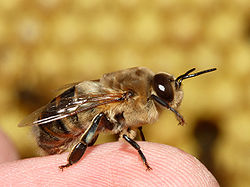
Caste System in The Honey Bee Colony: Drone, The Male


The Male Of The Honey Bee Colony: The Drone


     It comes as no surprise to beekeepers that most people, get a kick out of the fact that the hive is mainly female. This comes from the fact that 10 to 20 percent of the hive is male. The drone is easily spotted by their large eyes, medium size body and long legs.

     A drone is the result of an unfertilized egg. Normally, a Queen bee will deposit the unfertilized egg in a drone cell. A drone cell, compared to a worker cell, is slightly larger. Unlike the worker bee, the drone will take 24 days from egg to Adult.
     
     When the egg is laid it will take three days for the larva to hatch. On the 11th day the larva is mature enough to be(e) capped. This capped cell is easily noticed since the cell is dome shaped.
This is because the drone is slightly larger than the worker bee so it will need more space to develop in. On the 24th day the adult drone will emerge. Soon after the drone will begin his journey out of the hive. At the peak of summer there can be(e) about 200 drones on average.
     Drones do most of their flying in the afternoon. Their search in the afternoon is mainly to find a unfertilized queen bee to mate with. Interestingly enough, the drone will mate with the queen bee in midair and once he mates with the chosen queen he dies. But he has completed the task that nature has given him.

     Other than mating, Drones do not have any other specific task. They do not defend the hive since they do not have a stinger. For this reason they are easily picked up by a beekeeper with their bare hand! Additionally, the drone has a tiny proboscis, "tongue", and is not able to feed themselves. Thus, the worker bees must feed them.

     Later in the fall, the queen will lay fewer drones since mating season is over. As winter approaches, the worker bees will begin to drive the drones out of the hive. This phenomenon is the result of the hive no longer needing the drones for the winter and to conserve as much resources as possible.

     Thus the life of a Drone is over. Nevertheless, their numbers will reappear as mating season begins.

Tuesday, August 20, 2013

Planting Seeds for our Future

This year was one of many 'firsts' for CORE/El Centro's Garden and Nutrition program, including our first annual Kids Camp, held August 5-9th.  The 40-hour camp covered a number of topics through a variety of activities - from videos and coloring pages, to hands on soap making and composting.  Our 18 participants learned a lot, made new friendships and all left eager to return next year.

I'm including just a sampling of photos from the camp - more to come via video.  Enjoy!


Getting their hands dirty with Kompost Kids


Campers work to cut out pictures for their MyPlate project.

Finding pictures of the 5 food groups: Dairy, fruits, vegetables, grains, and protein.

All Finished! 

Painting the inside of their pizza box with black paint to absorb the sun's heat

Campers fill their solar oven pizza boxes with paper for insulation.

Solar oven pizza melting in the sun

A group shot after a presentation by Charlie, from Beepods. 

Decorating seed pots in preparation for planting

Saturday, August 3, 2013

Skin of the Earth

This Summer, I visited a friend in Minneapolis and made sure to make a stop at the University of Minnesota Bell Museum of Natural Science to check out Dig It! Secrets of Soil. The exhibit, organized by the Smithsonian Institute and supported as a traveling exhibition, offers a wealth of information and some hands-on activities examining this most precious of resource! 


The three main components of soil: sand, silt and clay combine to form Loam - the farmer's dream! 

This display shows the way that water flows through soil, depending on the size of particles.  Sand, being the largest particle, lets water run freely through while clay, the smallest particle, holds water.  When gardening we ideally have a healthy mix of all particles - allowing for some water retention, but also needing air and space for roots to grow into the soil and water to release as to prevent 'choking' the roots.

A very cool look below the surface - what diversity exists just in our country! 

One of my favorite parts of the exhibit was this area, showing different soil samples from around the U.S. It's a great reminder of how diverse our Earth is, and what incredible history She has!

Soil, taken from Antigo, to show Wisconsin's beautiful silt loam - prime soil for agrictulture

Wisconsin's State Soil, officially named in 1983, is Antigo Silt Loam, shown above.  Though Wisconsin has over 500 soil types, the Antigo Silt Loam is what has made our state a productive agricultural hub of the midwest. Over 10,000 years ago glacial meltwaters deposited sand and gravel in our area which now forms the lower subsoil and substratum (2-3 feet under ground).  Strong winds and further melting of glaciers then brought in the silt and loamy outwash which covered the lower sand/gravel deposits. These two layers ensure good soil drainage, while the hardwood forests of northern Wisconsin helped to develop the beautiful topsoil which has fed thousands of farming families and their customers.


Caption reads: What is 45% minerals, 5% organic matter, 25% water, and 25% air?  A midwestern farmer's dream - the ideal loamy soil.


Thursday, July 25, 2013

Caste System in The Honey Bee Colony: Worker Bee's Adulthood

 The Adulthood of a Worker Bee

In the last post about the Worker bee's we briefly showed how they change from egg to larvae to adult. Which starts off with the queen laying the egg in a CLEAN wax cell. after the larva hatches they are feed by the adult bees and eventually caped so they can fully change into an adult bee.

Her first three days as an adult will be(e) cleaning the cell from which she emerged. If not done properly the queen will not lay the next egg in that cell. As a result of poor cleaning the worker bee must clean the cell again. On her third to seventh day as an adult she is given the duty of nursing bee. At this stage her main task is to feed the worker larva royal jelly and eventually bee bread. Some worker bees are given the task of feeding the drones (more on this later) or the queen herself.

After their nursing career they are moved to, what I like to call, “Engineer “ bees. They are given the task of building, repairing, and designing the wax combs. It is very fascinating to watch them work in a top bar hive (like the one we have on the roof top). They start at the top of the bar and work their way down. First they make a bee “chain” to measure the part that they will be building. They use the wax that they excrete in order to construct the comb. Remember that the comb has two sides. So to optimize the strength of the comb it is built in a way that each cells’ corner is centered to the middle of the cell on the opposite side.  In additions to constructing the comb, they are also given the duty of storing the pollen and nectar that that forager bees bring in. They are the “engineerettes” of the hive from the 12th to the 17th day of their adult lifespan.
Our roof top ladies at work. Nice work, ladies!
The Shadow shows the offset that they create


The days 17 through 21 they worker bees do miscellaneous tasks around the hive. The tasks depend on what the hive needs the most. Some of the tasks include but are not limited to: honey sealing, Drone feeding, honey comb building, undertaker bee, fanning bees and water carriers.

One of the tasks that are given to worker bees is fanning. They are given the task of cooling the hives temperature by, you guessed it, fanning. They are their own air conditioning. They do this by standing in one place and sending an “air current” to one another. In some cases, they may add water to the “air current.”


On July 18th, 2013 it was 90+ degrees when we opened the hive and sure enough they were fanning away trying to keep the hive cool.
Another task that the worker bees do that I find interesting is “undertaker bee.” Normally a bee does not die inside the hive. When a bee feels like it is on its last seconds of life it will fly away as far as possible from the colony. Although when a bee does die in the hive another bee, in this case the undertaker bee, will carry it out as far as they can. However, the undertaker bee is not limited to only dead bees. It will also carry out eggs that never hatched, larvae that did not mature or adult bees that never made it out if their cells.

On the 22nd day of the worker bees’ adult life is moved to the task of forager. She will travel in a two to five mile radius to collect nectar and pollen. At the same time she will also pollinate the flowers that she visits. Thus, as she helps herself she will also help the plants and ultimately help feed us.  She is capable of visiting 50 to 100 flowers in one day. She will continue to forage until she dies. She is literally worked to death! So if you see a bee flying in and out of the hive then one can make an observational conclusion that the worker bee is on her last legs. But her hard work will not be in vain.

In the most active of months the average bee, after becoming an adult, will live 30 to 42 days. Nevertheless, every day and every task is crucial for the hive’s survival. All the bees tasks are, in one way or another, interconnected. It functions like a well-oiled machine. Take into consideration that without the “engineer” bees there wouldn’t be any space for the larva to grow and without the larva there wouldn’t be “engineer” bees. It leaves you with the head scratching question: “what came first? The wax comb or the bee?”

Stay tuned in for later blog post concerning the other caste of bees in the colony. Next up is the Drones, the males of the colony.
  
Written by Dulay.